cars, autos, automobiles, auto shows, concept cars, new cars, spy photos, news, gadgets, hybrids, electric vehicles, images, pictures, tuning, accidents, videos and much more...
Search Car
Saturday, August 28, 2010
Austin Healey Cars And The History Of It
Austin Healey Cars And The History Of It Part 2
Austin Healey Cars And The History Of It The End Part
Collector's Information
Austin Healey 100 Cars And The History Of It Part 1
Austin Healey 100 Cars
* 1953 - 1955 BN1 Austin Healey 100
* 1955 Austin Healey 100S (Extremely limited production of aluminium bodied race-prepared cars)
* 1955 - 1956 BN2 Austin Healey 100M (Limited production high performance)
* 1956 - 1957 BN2 Austin Healey 100
* 1956 - 1957 BN4 Austin Healey 100-6 (2+2 seats)
* 1957 - 1959 BN4 Austin Healey 100-6 Change to 1 3/4" SU Carbs (2+2 seats)
* 1958 - 1959 BN6 Austin Healey 100-6 6 Cylinder motor (2 seat)
Austin Healey 100 Cars And The History Of It
Girling 11 in (279.4 mm) drum brakes are fitted all round. Front suspension is independent using coil springs and at the rear is a rigid axle with semi elliptic leaf springs. The steering is by a cam and lever system.
A BN1 tested by The Motor magazine in 1953 had a top speed of 106 mph (171 km/h) and could accelerate from 0-60 mph (97 km/h) in 11.2 seconds. A fuel consumption of 22.5 miles per imperial gallon (12.6 L/100 km; 18.7 mpg-US) was recorded. The test car cost £1063 including taxes.
Austin Healey 100 Cars And The History Of It Part 3
The BN2 came with a real 4-speed manual transmission, still with overdrive on the top 2 gears. Other features that distinguish the BN2 from the BN1 are the slightly larger front wheel arches, different rear axle and being the first 100 with optional two-tone paint. The colour alternatives available to the 100 were: Reno Red, Spruce Green, Healey Blue, Florida Green, Old English White, Primrose Yellow, Black, and approximately 50 Gunmetal Grey cars. The BN2 two-tone colors were: White/Black; Reno Red/Black; Healey Blue/White; Black/Reno Red; and Florida Green/White. A 1956 BN2 100M (for Le Mans) model was developed as well, with larger carburettors, a cold air box to increase air flow to the carburettors, high-lift camshaft and 8.1:1 high compression pistons producing 110 bhp (82 kW) at 4500 rpm. The front suspension was stiffened and the bonnet gained louvres, along with a bonnet belt and most (approximately 70%) of them were finished with a two-tone paint scheme including two cars finished in unique color schemes: one White over Red and the other (for display at the 1955 London Motor Show) in Black over Pink. There were 640 factory built 100Ms -- all 1956 model BN2s. The 100M components (except for the high compression pistons) were also available as a Le Mans kit which could be installed in either a BN1 or BN2 with the engine in situ, improving the power output to 100 bhp (75 kW) at 4500 rpm. The Donald Healey Motor Company at Warwick retrofitted 519 cars with the Le Mans kit after they had been delivered to the original owners. The Le Mans kit and its component parts could be ordered from BMC, so additional cars were modified by Austin dealers and private owners.
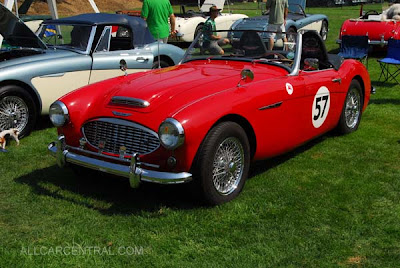
Built primarily with racing in mind, the aluminium-bodied "100S" (for Sebring) model developed 132 bhp (98 kW) at 4700 rpm. Only 50 production cars were produced, plus an additional five works development/special test cars which were hand built by the Donald Healey Motor Company at Warwick. The cast iron cylinder head was replaced by one made from aluminium and the overdrive unit was not fitted to the gearbox. Dunlop disc brakes were fitted front and rear. To keep weight to a minimum there were no bumpers or hood (convertible top), a smaller grille and the windscreen was plastic. The 100S was also the first production car in the world to sport disc brakes at both the front and rear. The car was approximately 200 lb (91 kg) lighter than standard. The majority of all 100S were two-toned White with Lobelia Blue sides. However, a handful of cars where ordered in Spruce Green, Reno Red and one single black 100S.
The final BN2 was produced in July 1956.
Austin Healey 100-Six(BN4-BN6) Cars And The History Of It Part 3
To make room for the occasional seats the wheelbase was increased by 2 in (50.8 mm). The bonnet had a built-in air scoop and the windscreen no longer could be folded down.
The cars used a tuned version of the BMC C-Series engine previously fitted to Austin Westminster which at first produced 102 bhp (76 kW) increasing to 117 bhp (87 kW) in 1957 by fitting a revised manifold and cylinder head. The overdrive unit became an option rather than a standard fitting.
In late 1957 production was transferred from Longbridge to the MG plant at Abingdon.
A 117 bhp (87 kW) BN6 was tested by The Motor magazine in 1959 had a top speed of 103.9 mph (167.2 km/h) and could accelerate from 0-60 mph (97 km/h) in 10.7 seconds. A fuel consumption of 20.8 miles per imperial gallon (13.6 L/100 km; 17.3 mpg-US) was recorded. The test car cost £1307 including taxes of £436.
Austin Healey 100-Six Cars
| 1958 Austin-Healey 100-Six (North America) | |
| Manufacturer | British Motor Corporation |
|---|---|
| Production | 1956-1959 |
| Class | Sports car |
| Body style(s) | 2-door roadster |
| Layout | FR layout |
| Related | Austin A90 |
Austin Healey 100 BN1 And BN2 Cars
| Production | 1953-1956 14,634 produced |
|---|---|
| Assembly | Longbridge, England West Bromwich, England |
| Successor | Austin-Healey 100-Six, series BN4 |
| Engine(s) | 2660 cc I4 |
| Transmission(s) | 3-speed (series BN1) or 4-speed (series BN2) manual |
| 90 in (2,286 mm) | |
| Length | 151 in (3,835 mm) |
| Width | 60 in (1,524 mm) |
| Height | 49.25 in (1,251 mm) |
| Fuel capacity | 12 imp gal (55 L; 14 US gal) |
Austin Healey 100-Six (BN4 and BN6) Cars
| Production | 1956-1959 14,436 produced |
|---|---|
| Assembly | Abingdon, England Longbridge, England |
| Successor | Austin-Healey 3000 |
| Engine(s) | 2639 cc C-Series I6 |
| Wheelbase | 92 in (2,337 mm) |
| Length | 157.5 in (4,001 mm) |
| Width | 60 in (1,524 mm) |
| Height | 50 in (1,270 mm) |
Austin Healey 3000 Cars And The History Of It Part 1
Austin Healey 3000 Cars
* 1959 - 1961 BN7 Mark I (2 seat), BT7 Mark I (2+2 seats)
* 1961 - 1962 BN7 Mark II (2 seat), BT7 Mark II (2+2 seats), BJ7 Mark II (2 seat)
* 1962 - 1964 BJ7 Mark II (roll-up windows)
* 1964 - 1967 BJ8 Mark III
The Austin Healey 3000 Cars is a British sports car built from 1959 to 1967, and is the best known of the 'big' Healey models. The car's bodywork was made by Jensen Motors, and the vehicles were assembled at the BMC Abingdon works.
The 3000 was a successful car which won its class in many European rallies in its heyday - and is still used in competition by enthusiasts today.
Austin Healey 3000 Cars And The History Of It Part 2
The original 3000 was built from March 1959 - March1961 and has model designation BT7 MkI (4 seat version) and BN7 MkI (2 seater).
13,650 were made (2,825 BN7 MkI, and 10,825 BT7 MkI).
A BT7 3000 with hardtop and overdrive tested by The Motor magazine in 1960 had a top speed of 115 mph (185 km/h) and could accelerate from 0-60 mph (97 km/h) in 11.7 seconds. A fuel consumption of 21.6 miles per imperial gallon (13.1 L/100 km; 18.0 mpg-US) was recorded. The test car cost £1326 including taxes.
Austin Healey 3000 Cars And The History Of It The End Part
In May 1964 the Phase II version of the MkIII was released, which had a modified rear chassis to allow rear ground clearance to be increased, and subsequently, in March 1965 the car also gained separate indicators.
Austin Healey 3000 Cars And The History Of It Part 3
A 3000 MkII BT7 with hardtop and overdrive tested by the British The Motor magazine in 1961 had a top speed of 112.9 mph (181.7 km/h) and could accelerate from 0-60 mph (97 km/h) in 10.9 seconds. A fuel consumption of 23.5 miles per imperial gallon (12.0 L/100 km; 19.6 mpg-US) was recorded. The test car cost £1362 including taxes.


